Every business leader understands the productivity upside of artificial intelligence. But for any company handling sensitive client files, supplier contracts, financial accounts, or patient records, enthusiasm is immediately followed by a reasonable question: where does our data go once it enters the model?
The fear of proprietary data leaking into public models, training a competitor's AI, or triggering an expensive regulatory fine is legitimate. But the risk does not come from AI itself; it comes from treating enterprise software engineering like a consumer web tool.
Consumer chatbots vs. commercial APIs: where data actually goes
The most common confusion in business today is mixing up consumer chatbots with commercial developer APIs. When an employee pastes text into the free or standard web version of ChatGPT or Claude, the default terms of service often permit that text to be retained and used to train future model iterations.
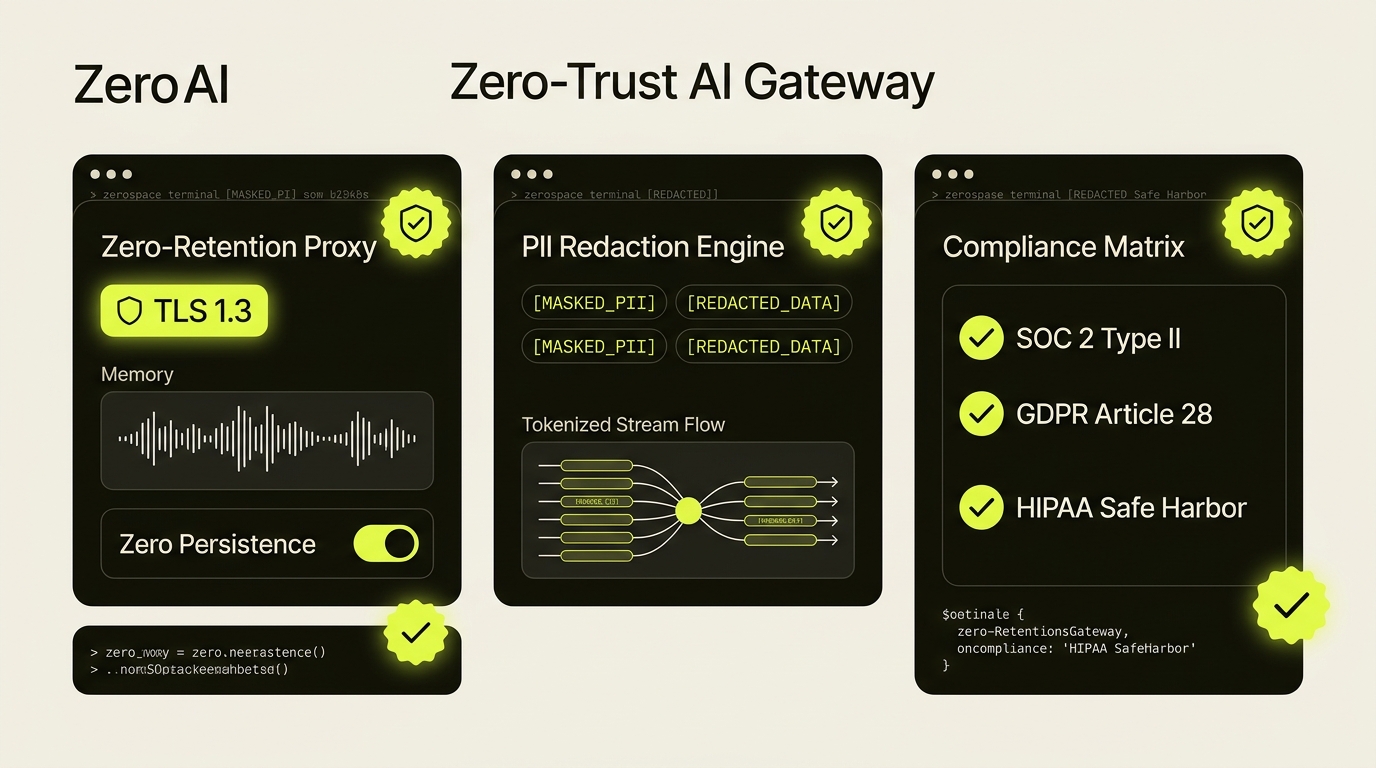
When engineers build an automated business workflow using commercial developer APIs (such as OpenAI's business API, Azure OpenAI, or AWS Bedrock), an entirely different legal and technical agreement takes effect. Under commercial API terms, Zero Data Retention (ZDR) is contractually binding: prompts and responses are processed in temporary memory and are never used to train foundational models.
Never let staff paste customer records or financial spreadsheets into consumer browser chatbots. All business AI automations must route strictly through commercial API tiers covered by enterprise Data Processing Agreements (DPAs).
The three layers of AI data defense
To comply with GDPR, SOC 2, and data protection law, an automated AI workflow should enforce three layers of protection before data leaves your network:
Before an invoice or customer ticket is sent to an external AI model, run the text through a local deterministic scrubber. Names, phone numbers, and payment details are stripped and replaced with synthetic placeholders like [CUSTOMER_NAME]. The AI reasons over the anonymized text, and your local server restores the real details once the response returns.
Rather than calling shared public URLs, route AI traffic through dedicated private cloud instances — such as Azure OpenAI inside your own Microsoft tenant. Data stays within your geographic region, traffic is encrypted in transit via TLS 1.3, and data is protected at rest with customer-managed keys.
If you build an AI retrieval system (RAG) over company documents, never dump multiple clients or departments into an unpartitioned vector database. Enforce strict metadata filtering and automated deletion schedules so customer data can be purged on demand to satisfy GDPR's Right to Be Forgotten.
When to run open-weights models locally
For organizations with absolute data sovereignty mandates — such as law practices, clinical medical groups, or defense contractors — even an encrypted enterprise connection to a cloud provider may violate policy.
For these teams, the answer is running open-weights models (such as Llama 3 or Mistral) on a private local server or air-gapped virtual machine. Modern small models running on a dedicated workstation can categorize documents, parse invoices, and summarize text with zero bytes of data leaving your building.
Enterprise data privacy in AI is not a philosophical promise. It is an architectural boundary enforced by network rules, API contracts, and cryptographic access controls.
The five-point AI security audit
Before approving any AI automation project, verify these five requirements with your team or vendor:
Ensure commercial enterprise endpoints are used, with written confirmation that prompts are not stored for model training.
Verify that personal identifiers and payment data are stripped before payloads leave your server.
Ensure all AI services are billed directly to accounts in your company's name, not a third-party agency's account.
Ensure the model returns structured JSON validated against strict schemas, preventing hallucinations from breaking downstream systems.
Keep a timestamped log of every prompt, completion, and system action for internal compliance.
Common questions
Does using OpenAI or Anthropic commercial APIs train public models on our company data?
No. Commercial developer API tiers — as well as Azure OpenAI and AWS Bedrock — do not use customer API payloads to train foundation models, and enterprise Zero Data Retention (ZDR) endpoints process prompts in memory without persisting logs.
How do you keep customer PII out of external AI models under GDPR?
Run a deterministic local redaction step before the API call to replace names, email addresses, phone numbers, and account numbers with synthetic tokens, let the model process the scrubbed structure, and re-hydrate real values inside your own server.